
Week 2 – Peace
Justice is the Path to Peace
Blessed are the peacemakers, for they will be called children of God.
Matthew 5:9
Pray
God our Lord,
We come to you in this darkness,
Hard-pressed on every side, but not crushed;
Persecuted, but not abandoned;
Struck down but not destroyed;
Because we carry your Sumud (steadfastness) in our souls.
God who lifts our burdens,
Lift the rubble and rescue those underneath,
With your mighty hand bring them from the edge of death back to life.
Clear the air from the smell of burning,
Infuse our land with your fragrance of salvation.
God who dwells in the praises of his people,
Sit in the pews of the churches of Gaza,
Steady the hearts of the worshippers as the airstrikes shake the ground beneath their feet.
Listen to our children reciting the prayer as you taught us:
“Your kingdom come, Your will be done on earth as it is in heaven.”
God of life,
As we watch our world crumble around us,
As we experience heartbreak and disappointment,
Foster in us a divine imagination,
One that can see the wall come down,
One that can see the siege lifted,
One that can see all inhabitants of the land living in security and peace,
One that can still believe of a life abundant.
Prayer adapted from Dr Lamma Mansour’s “A Prayer of Lament and Hope”, 2023. Listen to the full prayer here.
Additional Prayer via Sabeel Ecumentical Liberation Theological Center Jerusalem’s Wave of Prayer – This weekly publication powerfully and prophetically responds to the previous week’s news across Palestine/Israel.
Engage
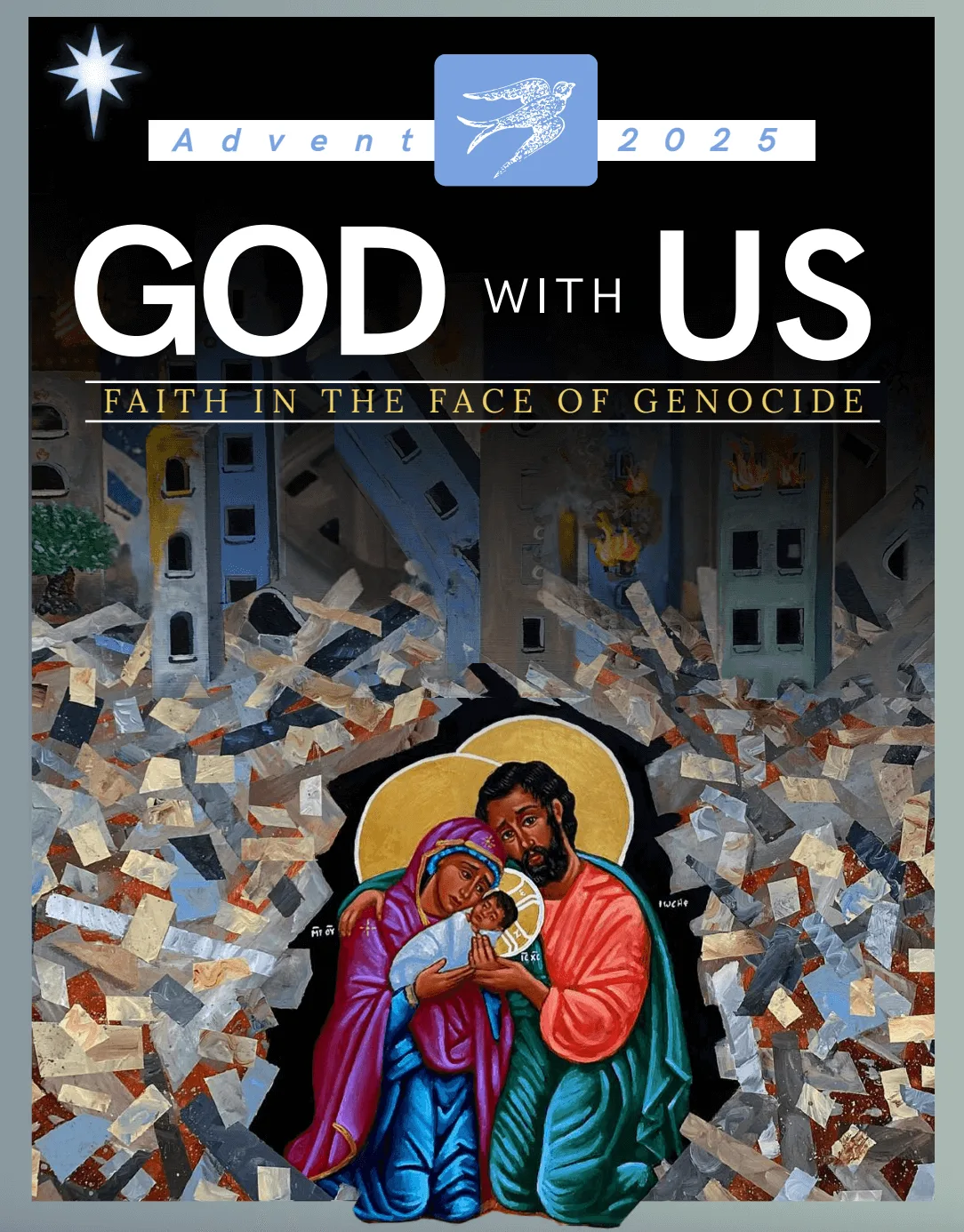
God With Us: Faith in the Face of Genocide
During each of the days of Advent, read a reflection by a Palestinian Christian. Let these essays invite you into a deeper understanding of Christ’s birth, and remember that God is with all those who suffer violence and feel the crushing foot of empire. God is under the rubble in Gaza. The coming of Christ—and the way Christ comes—is the most profound act of divine solidarity the world has ever seen.
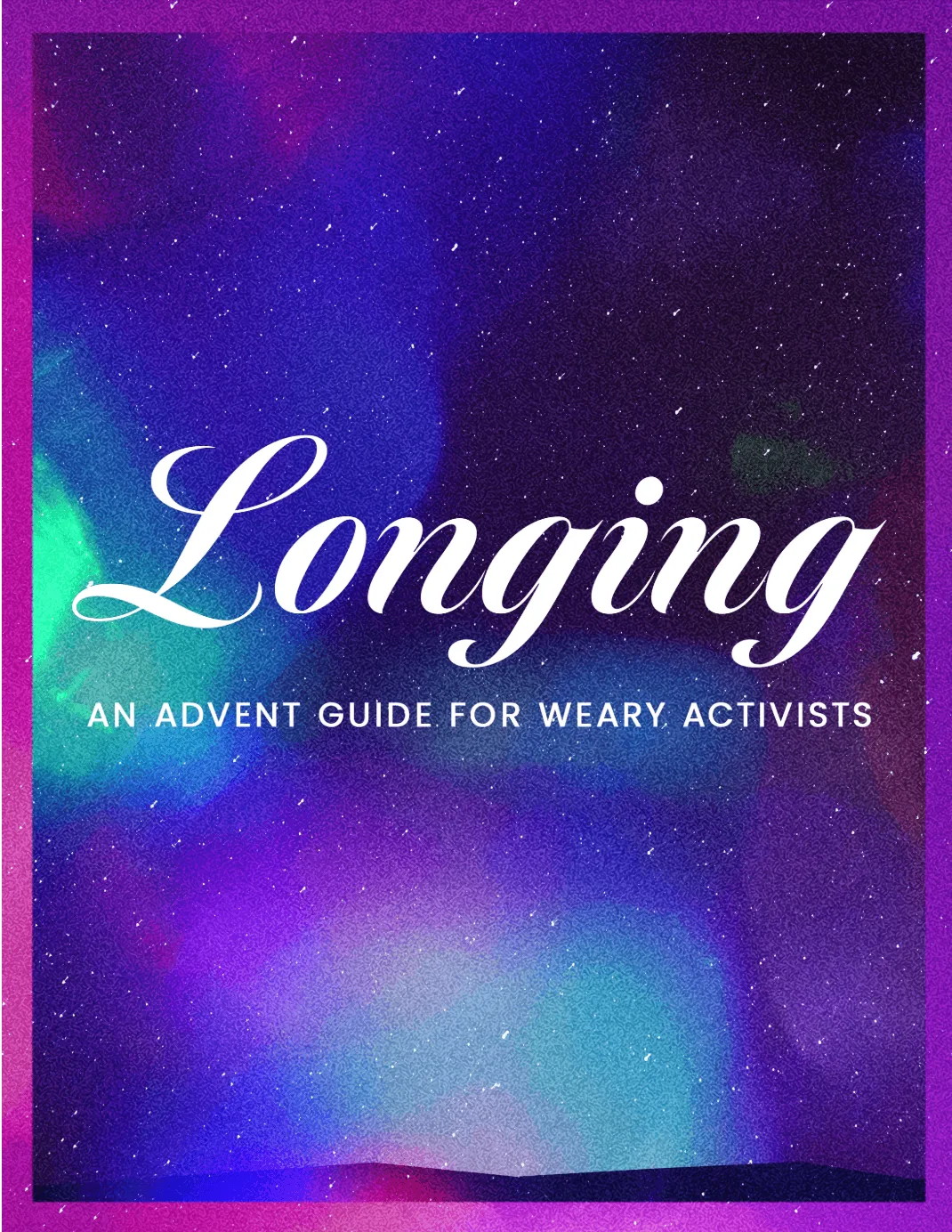
Longing: an Advent Guide for Weary Activists
Advent is an invitation to make space for the longing of “not yet”. It is a time of the year where we join our sisters and brothers all over the world to remind ourselves that Creator is not done. We acknowledge that things are not as they should be and we intercede and express our longing. Explore the themes of liberation, healing, flourishing, and beauty through this Advent guide.
Reflect
Jerusalem—the City of Gates
By Marion Sarkisian Ramón Pareja
There are few places on earth where holiness feels so close you can almost touch it—and yet so guarded you can barely breathe. Jerusalem is that place. Stone upon stone, prayer upon prayer, century after century—the city glows with devotion and hums with division.
To enter its gates, you pass under the ever watchful eye of surveillance cameras and heavily armed border police. Pilgrims clutch rosaries beside soldiers gripping rifles. The air carries both incense and tension, hymns and warnings. Here, faith and fear walk the same narrow streets.
“My house shall be called a house of prayer for all peoples.”
— Isaiah 56 : 7
But the house of prayer is fenced with gates. In the Old City, light falls on the gold of the Dome, the gray of the Wall, the worn limestone of the Church of the Holy Sepulchre. All shimmer beneath the same sun, all shadowed by the same sorrow.
At each corner, a soldier watches. At each gate, there is a line: those who may enter, those who must wait. For Palestinian Christians living in the West Bank, a visit to Jerusalem requires a permit, an interrogation, and a measure of luck. The road to Calvary begins at a checkpoint. The way to worship winds through bureaucracy and oppression.
And yet, within those gates, the bells still ring. Religious leaders still walk the ancient alleys carrying icons and incense, their footsteps echoing off stone. Children run ahead, laughing, their sound momentarily louder than the loudspeakers that announce control. Faith endures. It keeps moving. It finds paths where none should exist.
“As Jesus approached Jerusalem and saw the city, He wept over it and said,
‘If you, even you, had only recognized on this day the things that make for peace…’”
— Luke 19 : 41–42
Two thousand years ago, He stood on this same ridge, looking over these same hills, and wept. He saw then what we see now—how sacredness can become possession, how love can harden into law, how peace can be traded for power.
If He walked here again today, He would find streets lined with surveillance cameras and banners of nationalism where once the poor were welcomed and healed. He would pass through the eyes of soldiers to reach the Mount of Olives, where graves now overlook a city that still does not know the things that make for peace. And maybe he would weep again.
For amid the noise and narrowness, there are still those who refuse to stop praying. Women lighting candles in cool chapels. Monks chanting beneath domes. Ordinary people pausing to look one another in the eye across lines drawn in fear. Every one of them a quiet gate through which mercy enters the city again.
Jerusalem teaches us that holiness does not protect us from conflict—it reveals it. The same city that holds the empty tomb also holds security checkpoints and barbed wire. Here, the sacred and the profane live side by side: prayer rising from the lips of the detained, grace flickering in the glare of searchlights.
And maybe that’s what the Gospel was always trying to tell us: that peace is not a place we inherit—it’s a practice we must keep choosing. That God still walks the streets of this city, uninvited but unforgotten, looking for those who will open the gate.
This Advent, we light a red candle for Jerusalem—for the city of peace that has forgotten how to rest. For the pilgrims turned away, for the faithful who keep praying in narrow alleys and crowded courtyards, for the dream that still flickers between its stones.
Light a candle.
Pray for Jerusalem.
Because peace is not naive—it’s the work of those who keep their hearts open when every gate is closed.
Still, Christ is born among those the world forgets.
Still, light finds a way through stone and steel.